Churchill’s WWII Oxygen Mask: The Incredible Story of High-Altitude Cigar Smoking
Sir Winston Churchill is universally remembered for his steadfast leadership, historic wartime speeches, and an nearly permanent cigar clenched between his teeth. The British Prime Minister smoked an estimated eight to ten cigars a day throughout his adult life, consuming over 200,000 sticks in his lifetime. His devotion to fine tobacco was so absolute that not even military protocol, international travel, or the physiological constraints of 15,000-foot altitudes could separate him from his beloved smokes.
One of the most remarkable, and lesser-known, chapters in aviation history unfolded during World War II, when RAF engineers and respiratory specialists were tasked with solving a unique diplomatic problem: how to let the Prime Minister smoke a cigar through an airtight oxygen mask at high altitude.
High-Altitude Diplomacy in Unpressurized Skies
During the height of World War II, Churchill traveled tens of thousands of miles across Europe, North Africa, and North America to confer with Allied leaders like Franklin D. Roosevelt and Joseph Stalin. In the early 1940s, military transport aircraft lacked the pressurized cabins common in modern aviation.
To avoid enemy fighter planes and anti-aircraft fire, Churchill’s flights routinely soared above 15,000 feet. At these altitudes, thin air and freezing temperatures meant passengers had to wear heavy flight suits and rubber oxygen masks to prevent hypoxia. For most travelers, wearing a mask for hours was a minor inconvenience. For Churchill, being unable to light up for an entire flight was completely unacceptable.
The Custom RAF "Cigar Mask"
On the eve of a high-altitude mission in 1942, Churchill summoned his flight team and made a characteristic demand: he requested a specialized oxygen mask designed specifically so he could smoke his cigars while airborne.
Dr. Edgar Pask, a pioneering expert in respiratory physiology at the Royal Air Force Physiological Research Station at Farnborough, took up the challenge. Pask modified a standard RAF rubber oxygen mask, installing a sealed aperture and a custom cigar-holder fitted with a special side tube and non-return valve. This allowed pressurized oxygen to flow into the mask while creating a safe pass-through slot for a lit cigar.
Because pure oxygen is highly flammable, creating a device that brought open embers inches from a concentrated oxygen flow was a high-stakes engineering puzzle. Initial laboratory prototypes produced surprising results—if a smoker accidentally covered the holder opening with their tongue, oxygen would flow backward out through the cigar, causing the tobacco tip to erupt into a brief white flare. After refined adjustments, the RAF delivered a functioning prototype directly to the Prime Minister.
A Habit That Defined an Era, and a Vitola
Churchill was so famous for his preference for large, heavy-gauge Cuban smokes, specifically Romeo y Julieta and La Aroma de Cuba, that the industry eventually named an entire cigar size after him. Today, any classic 7-inch by 47-ring-gauge stick is universally known as a Churchill. You can explore the history, dimensions, and profile of this iconic shape in our detailed guide on what is a Churchill cigar.
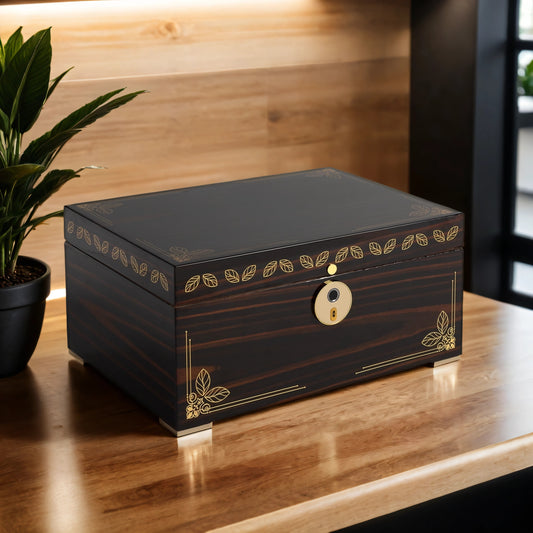
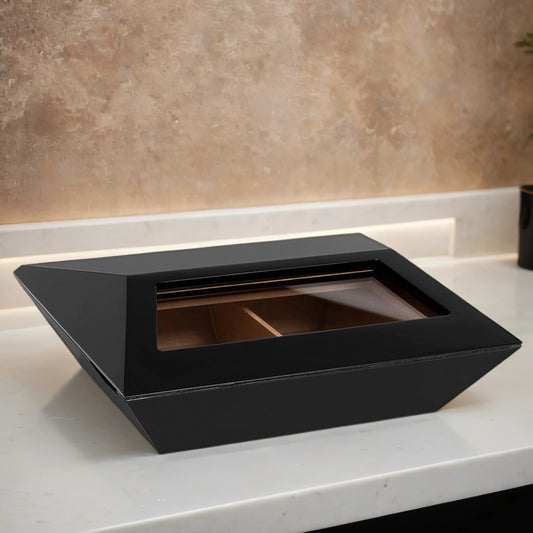
Whether sitting in the Cabinet War Rooms, flying across the Atlantic, or relaxing at his Chartwell estate, Churchill maintained a massive personal reserve of thousands of cigars. To keep such an enormous collection fresh in the humid climate of Chartwell Manor, his valets kept his sticks carefully sorted and conditioned. For modern enthusiasts keeping their own collection in prime smoking condition, investing in quality humidors is essential for preserving delicate essential oils and wrapper wrapper leaves.
Savoring the Craft
While few modern smokers will ever need to engineer an oxygen mask to enjoy a smoke at 15,000 feet, the principles of appreciating fine tobacco remain unchanged. Churchill was famous not just for smoking continuously, but for taking his time, puffing slowly to prevent the leaf from overheating and bittering.
To get the most out of your own sticks without overheating the cherry or ruining the burn, check out our step-by-step masterclass on how to smoke a cigar properly.
The Legacy of the Flying Bulldog
Churchill's modified oxygen mask remains one of the most eccentric footnotes in World War II history, a testament to a leader who refused to let war, physics, or military protocol disrupt his daily rituals. It stands as proof that for true aficionados, a great cigar is more than a smoke; it’s an indispensable source of comfort and resolve, no matter how high you fly.