
The Ideal Humidity for Cigars: Why 70% RH is Not Always the Answer
Finding the best humidity for cigars is the most debated topic in the world of premium tobacco. While the traditional rule of thumb suggests a steady 70% relative humidity (RH) at 70 degrees Fahrenheit, modern enthusiasts and industry experts have found that a slightly lower range often yields a superior smoking experience.
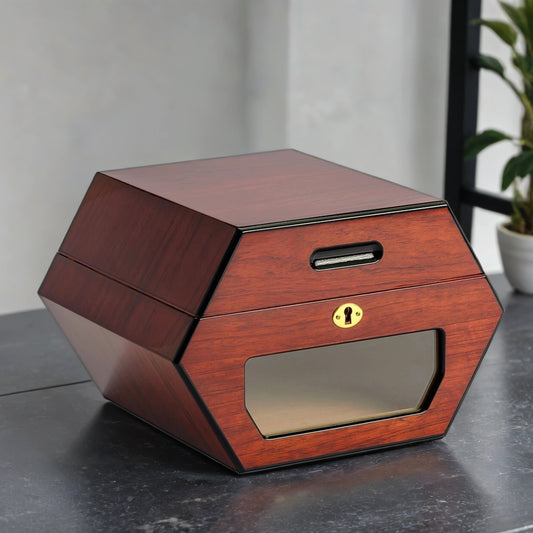
Maintaining the correct moisture level is about preserving the delicate essential oils and lipids within the tobacco leaf. A balanced humidor ensures your cigars are structurally sound, while an imbalanced one risks total loss. If you’re tired of fighting with humidity swings, it may be time to upgrade to a professional-grade cigar humidor built from premium Spanish cedar.
The Science of Relative Humidity and Temperature
Relative Humidity (RH) measures how much moisture the air holds compared to the maximum amount it could hold at a specific temperature. Because cigars are hygroscopic, they naturally breathe, absorbing and releasing moisture to match their environment.
The relationship between temperature and humidity is vital. Warmer air can hold significantly more water vapor than cold air. This means 65% RH at 75 degrees feels much "wetter" to a cigar than 65% RH at 62 degrees. To protect your investment, aim for a stable temperature between 65 and 70 degrees Fahrenheit alongside your target humidity.
Modern Standard: The old "70/70" rule is being phased out. By dropping your humidity to the 64% to 67% range, you allow tobacco to combust more cleanly, unlocking nuanced notes of cocoa and spice that higher humidity can "mute." Explore our high performance desktop humidors to maintain these precise levels.

The Optimal Humidity Storage Matrix
| Situation or Cigar Origin | Target Humidity (RH) | Primary Benefit |
|---|---|---|
| New World (Nicaraguan) | 66% to 68% | Keeps oily wrappers supple |
| Cuban Cigars (Habanos) | 62% to 64% | Prevents tight draws and plugs |
| Long Term Aging | 65% to 69% | Preserves essential oils over years |
| Daily Smoking Stash | 64% to 65% | Ensures an even burn and clean ash |
| Dry/Arid Climates | 68% to 70% | Offsets moisture loss during opening |
Managing Your Humidor Environment
When Humidity Is Too High
If your hygrometer consistently reads above 70%, you must prevent mold. Briefly open the lid for an hour to cycle the air. You can also utilize "dry boxing," moving cigars to an unhumidified cedar box for 24 hours before smoking.
When Humidity Is Too Low
Dry cigars burn hot and harsh. If levels dip below 62%, ensure your humidification source is charged with distilled water. If the wood feels dry, you may need to refer to our guide on How to Season a Humidor.
The Truth About Mold and Plume
Recent lab testing has confirmed that nearly all instances of "plume" are actually white mold. While white mold can often be wiped off, green or blue fuzzy spots indicate a deep infestation. Mold is a clear sign your humidity is too high or your temperature is exceeding 72 degrees.

Expert Tip: Acclimation Period. Always allow newly shipped cigars to rest in your humidor for two to four weeks. The stress of transit causes humidity swings that need to stabilize.
Expert Tip: Airflow. Do not pack your humidor so tightly that air cannot circulate. This prevents "wet pockets" where mold can grow hidden from your hygrometer.
Frequently Asked Questions
Is 62% humidity too low for cigars?
For most, 62% is the lower safety limit. However, for Cuban cigars or airtight acrylic humidors, it is often the "sweet spot" for a perfect draw. If wrappers feel brittle, gradually raise RH to 65%.
Can I mix different humidity levels in the same humidor?
No, RH will naturally equalize. If you have a diverse collection, aim for a "neutral" 65% RH, which is safe for both delicate Habanos and oily New World sticks.
Does temperature affect the risk of tobacco beetles?
Yes. Beetles remain dormant below 70°F. If temperature exceeds 72°F and humidity is high, the risk of an outbreak increases significantly. This is why many prefer humidors with active cooling systems.